
How TMS Rewires the Brain
If you’ve ever wondered “How does TMS actually work?” you’re not alone.
Most people understand that Transcranial Magnetic Stimulation is noninvasive, safe, and medication-free — but the “how” behind it can feel mysterious.
The good news?
TMS is based on a very simple idea:
Healthy brain circuits communicate clearly. Depression disrupts those circuits. TMS strengthens and restores them.
This post breaks the science into a few easy pieces — no neuroscience degree required.
The Big Picture: Depression Is a Circuit Problem
For decades, depression was explained mostly in terms of “chemical imbalances.”
But modern neuroscience tells a clearer story:
Depression disrupts communication between key mood-regulating areas of the brain.
The most important of these are:
- Left dorsolateral prefrontal cortex (DLPFC) → motivation, planning, emotional regulation
- Deeper limbic areas (amygdala, subgenual cingulate) → emotional intensity, threat response, negative loops
When the connection between these areas becomes weak or underactive, the brain can get “stuck” in patterns of:
- low motivation
- hopelessness
- emotional overwhelm
- repetitive negative thoughts
- inability to feel pleasure
This is where TMS comes in.
If you want a basic overview first:
What Is TMS? (New Chapter TMS)
How TMS Stimulates and Strengthens Brain Circuits
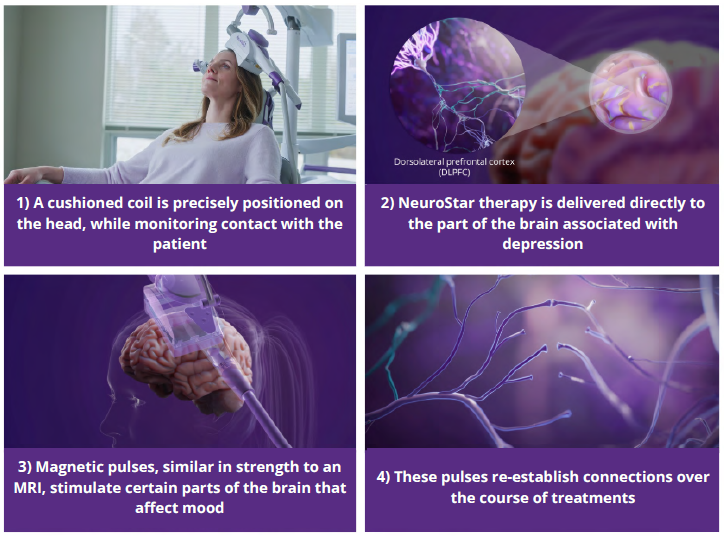
TMS uses focused magnetic pulses (similar strength to an MRI) to gently activate the DLPFC — the same area shown to be underactive in people with depression.
A great summary of how this works can be found here:
Harvard Health: “Transcranial magnetic stimulation for depression”
Here’s what that activation achieves:
1. It “wakes up” underactive brain cells
The left DLPFC tends to be less active in depression.
TMS repeatedly stimulates this region — like physical therapy for the brain.
2. It strengthens communication between mood circuits
Over repeated sessions, TMS helps rebuild signaling between the DLPFC and deeper limbic structures.
This is neuroplasticity — the brain forming and strengthening connections.
3. It helps the brain regulate emotions more effectively
Patients often describe:
- clearer thinking
- more emotional balance
- better motivation
- fewer negative loops
These aren’t placebo effects — they reflect measurable changes seen in imaging studies.
What Does “Rewiring” Actually Mean?
“Rewiring” is not a metaphor. TMS creates real, lasting changes:
Neurons fire more efficiently
Repeated pulses strengthen normal firing patterns.
Pathways between brain regions strengthen
Neural “roads” become clearer and faster.
The brain becomes more flexible
People describe feeling “unstuck,” less trapped in negative thought cycles, and more capable of shifting emotional states.
For many patients, this translates into finally feeling like themselves again.
Why This Matters for Both Adults and Teens
One of the most hopeful findings in recent years:
Teens may respond even faster to neuroplasticity-based treatments like TMS.
Adolescent brains naturally have higher neuroplasticity — they form new connections quickly. The FDA cleared TMS for ages 15–21 in 2024.
A great parent-forward overview can be found here:
Child Mind Institute: “TMS Treatment for Depression”
If you’re exploring TMS for your teen, you may also want to read:
Depression & Treatment-Resistant Depression
The Experience: What It Actually Feels Like
Many people imagine electricity, jolts, or dramatic sensations — but the real experience is simple, calm, and surprisingly easy:
- You sit comfortably in a treatment chair
- A small magnetic coil rests gently against your scalp
- You feel tapping or clicking sensations
- You can read, talk, or listen to music during treatment
- You drive home immediately afterward
No sedation, no memory loss, no “shock therapy.”
Why TMS Works When Medications Sometimes Don’t
Medications work through the bloodstream.
TMS works directly on mood circuits in the brain.
That’s why TMS can help when:
- multiple medications haven’t worked
- side effects are too difficult
- depression keeps returning
- anxiety is overwhelming
- fatigue and low motivation persist
TMS is not a replacement for therapy or medication — it’s an entirely different tool that targets the root of the problem.
The Bottom Line: TMS Helps the Brain Get “Unstuck”
The simplest way to say it:
TMS strengthens the brain pathways that depression weakens.
When those pathways fire normally again, people often notice:
- improved mood
- renewed motivation
- clearer thinking
- better emotional resilience
- fewer negative thought spirals
For many, this is when life finally starts to feel like their own again.
Want to See Whether TMS Could Help You?
If depression or anxiety has left you feeling stuck — even after trying medications or therapy — TMS may be the right next step.
We’re here to help you understand your options. Contact New Chapter TMS to ask questions or schedule a consultation.